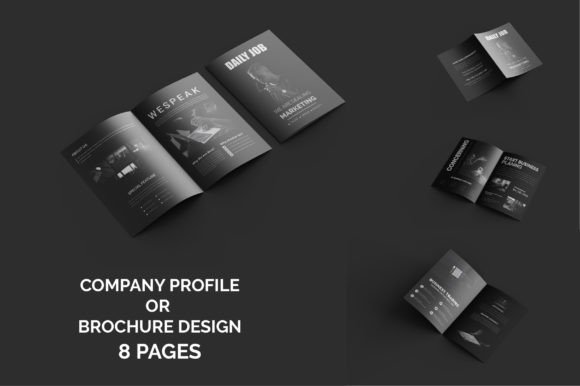
Professional Black & White Company Profile and Brochure Design
Every business, whether it's a startup finding its voice or an established firm reinforcing its market position, faces the same fundamental challenge: how to present complex information in a way that is not only digestible but also compelling. We often get caught up in the digital noise—social media algorithms, SEO updates, and email open rates—that we forget the power of a tangible, well-structured document. A company profile is more than just a list of services and a mission statement; it is the narrative backbone of your business. It’s the first impression you leave on a potential investor, the deciding factor for a client choosing between you and a competitor, and the reference point for your team’s alignment. The problem is that creating a professional, cohesive document from scratch is time-consuming and often expensive if you hire a design agency. This is where the value of a high-quality template comes into play. A template isn't just a shortcut; it's a framework for professional communication. The "8 Page Company Profile or Bi Fold Brochure Design in Black" is a specific asset designed to solve this problem. It offers a structured, visually striking layout that allows you to input your data without worrying about kerning, margins, or color theory. It’s a tool that bridges the gap between a rough idea and a polished, print-ready PDF.
The Psychology of the Bi-Fold Format
Why choose a bi-fold brochure or an 8-page profile over a single sheet or a massive booklet? The answer lies in psychology and usability. A single sheet can feel flimsy, while a 50-page annual report can feel like homework. The bi-fold, which typically yields four panels (front cover, two inside panels, and a back cover), or an 8-page saddle-stitched booklet, hits a sweet spot. It forces you to be concise. You have limited real estate, which means you must prioritize your most compelling information. For a client, this format is easy to hold, easy to flip through, and easy to file away. It feels substantial in the hand but doesn't demand hours of reading time.
The "black" aesthetic of this specific template plays a crucial role in this psychology. Black is universally associated with authority, sophistication, and modernity. Think of high-end fashion brands, luxury tech companies, or elite consulting firms. They often rely on black because it provides a neutral, powerful backdrop that makes other elements—like your logo, your product photography, or your typography—pop. Using a black template signals that you take your business seriously. It’s a visual shortcut to credibility. However, it also requires discipline. A black background can be tricky if you have low-resolution images or if your brand colors are too dark, as they will get lost. This is why the template's design is so specific: it’s built to handle the contrast, ensuring that your white text is crisp and your colored accents are vibrant.
Practical Applications Beyond the Boardroom
While the primary use case is obvious—presenting your company to potential clients—the versatility of a high-quality company profile or brochure design extends much further. If you are a small business owner, you might use this template to create a "lookbook" for your seasonal products. If you are a freelancer, it becomes a portfolio case study. If you are a non-profit, it serves as a donor packet. The structure is there to guide you, but the application is up to you.
Consider the digital landscape as well. In an era of remote work and virtual meetings, the PDF has become a ubiquitous format for sharing information. Instead of sending a long email chain with attachments, you can send a single, beautifully designed PDF that opens with your cover page. This is particularly useful for sales teams. A rep can walk through the document during a Zoom call, using each page or panel as a talking point. The visual consistency of the template ensures that every team member is presenting the same brand image, which is vital for brand recognition. You aren't just sending information; you are sending a branded experience. This template can also be adapted for digital products. For example, an educator could use the layout to create a paid workshop guide, or a coach could use it to package a set of exercises. The file formats provided—Ai, EPS, PDF, and JPG—ensure that you can work in the software you are most comfortable with, whether that's Illustrator or a simpler PDF editor.
Designing for Impact: Color, Contrast, and Hierarchy
The visual appeal of a company profile is not accidental; it’s the result of deliberate design choices. One of the biggest challenges in creating a profile is establishing a clear visual hierarchy. Your reader needs to know where to look first, second, and third. This template handles that through its layout and its use of the color black. By using large blocks of black, it creates "zones" for different types of content. A splash page might be entirely black with a white headline, signaling a new section. A content page might use a black sidebar to separate your core values from a client testimonial.
Color mode is another critical factor that this template addresses. It’s designed in CMYK, which stands for Cyan, Magenta, Yellow, and Key (Black). This is the standard color model for professional printing. If you design your profile in RGB (the color model for screens) and then send it to a printer, the colors will shift, often appearing duller or less saturated. By providing the files in CMYK, the template ensures that what you see on your screen (assuming it's calibrated) is what you get in the final print. The 300 DPI (dots per inch) resolution is equally important. This is the standard for high-quality printing. Anything lower, and your images or text might look pixelated or blurry when printed. This technical foundation allows you to focus on the creative side—choosing your images and writing your copy—without worrying about technical print errors.
Typography and Readability: The Unsung Heroes
When people look at a design template, they often focus on the layout and the images. But the typography is what actually carries the message. A beautifully designed page is useless if the text is too small to read, too cramped, or set in a font that clashes with the brand's voice. This template uses "free fonts," which is a significant advantage for small businesses and startups. It means you don't have to purchase expensive font licenses to use the design. You can download the fonts, install them, and start editing immediately.
But it’s not just about cost; it’s about compatibility. The fonts chosen for this template are likely selected for their readability against a black background. White text on black can be harder to read than black text on white, especially for long paragraphs. This is because the white background emits more light, making it easier for the eye to focus. To counteract this, designers often use a slightly off-white or a specific sans-serif font with generous spacing. The template likely incorporates these best practices. When you edit the text, pay attention to the font size and the line spacing (leading). Don't be tempted to shrink the font to fit more information. If you have too much text, you need to edit your copy, not your font size. The goal is to make the reading experience effortless. If a client has to squint to read your value proposition, you’ve lost them. The template provides the structure, but you must respect the readability principles it was built on.
Customization: Making the Template Your OwnA template is a starting point, not a finished product. The real value comes when you inject your brand’s personality into it. The "Easy to Edit" feature mentioned in the template description is key here. In Adobe Illustrator or a similar vector editor, you should be able to change the colors, swap out placeholder images, and adjust the layout to suit your specific content. However, there are a few best practices to follow when customizing. First, maintain consistency. If you change the font on one page, change it on all pages. If you use a specific shade of blue for your headers, use that same shade everywhere. Inconsistency looks unprofessional and erodes trust.
Second, be mindful of the "100% vector" aspect. Vector graphics are made of paths and points rather than pixels. This means they can be scaled to any size without losing quality. This is incredibly useful if you decide to turn your 8-page profile into a large-format poster for a trade show. You can take the cover design and blow it up to 6 feet tall, and it will still look crisp. However, it also means that you need to be careful with your own assets. If you insert a low-resolution JPG logo, it will look blurry next to the crisp vector text. Always use high-resolution images and vector logos when customizing. The template is designed to be a professional asset; your additions should meet the same standard.
The Business Case for Professional Presentation
Ultimately, investing in a professional company profile or brochure design is an investment in your business’s credibility. It’s a tangible representation of your brand’s values. A sloppy, poorly designed profile suggests a business that is disorganized or doesn’t pay attention to detail. A sleek, well-structured profile suggests competence, reliability, and professionalism. It’s a silent ambassador for your brand. Whether you are a startup trying to secure your first round of funding, a freelancer looking to land a high-value client, or an established company refreshing your image, the tools you use matter. This template provides a high-quality, versatile, and technically sound foundation. It removes the guesswork from design and allows you to focus on what you do best: running your business. The black aesthetic is timeless, the format is practical, and the technical specifications ensure a professional result. It’s not just a file; it’s a strategic asset for your brand’s communication.